
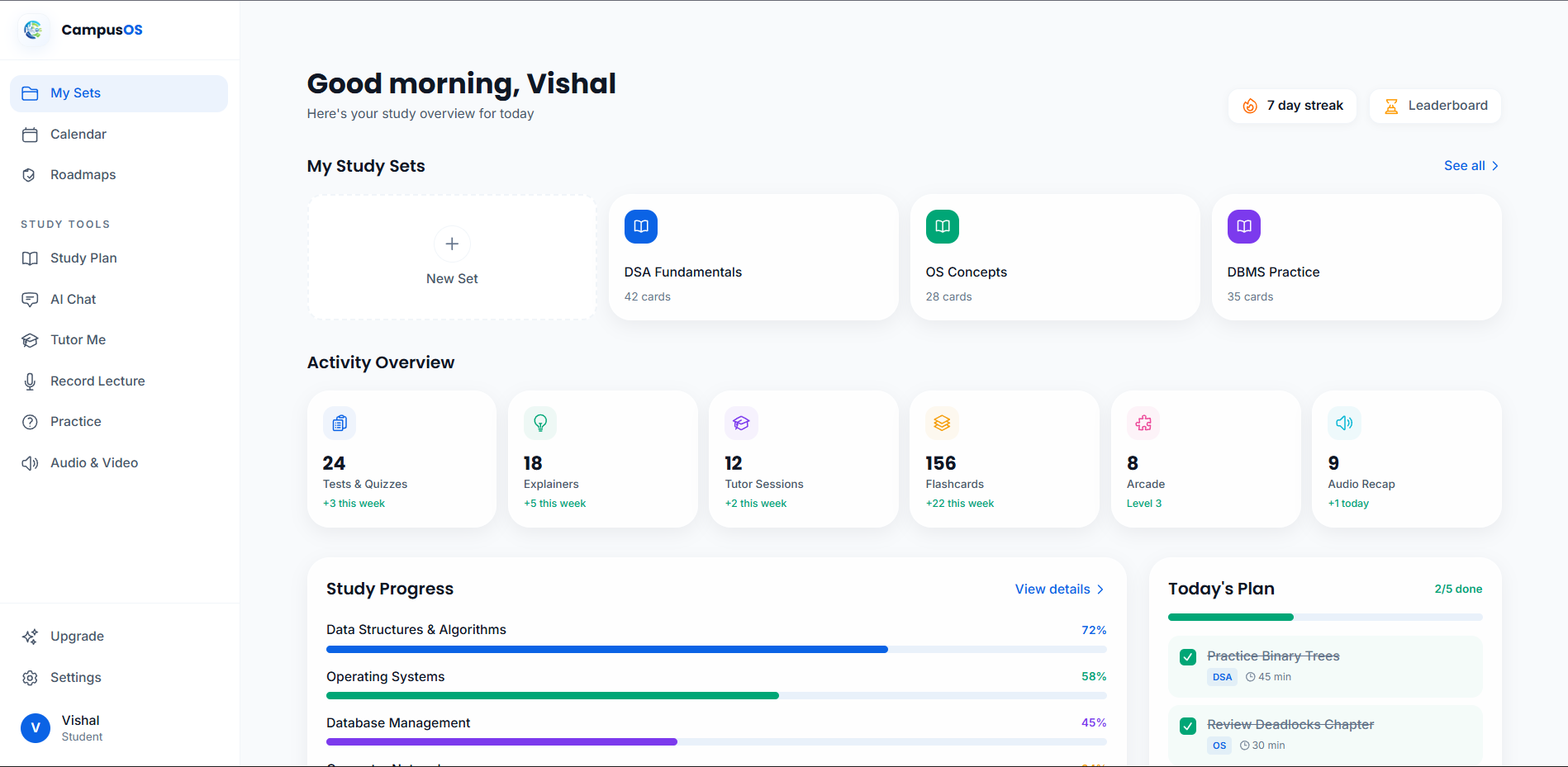
CampusOS
A student-focused platform built with MERN, JWT auth, role-based workflows, AI automation, and cloud-backed deployment.
Timeline
2024 - Present
Role
Full Stack Developer
Team
Core Team
Status
CompletedTechnology Stack
Key Challenges
- Building role-based workflows for different student personas
- Implementing secure auth and protected routes
- Handling feature growth without hurting performance
Key Learnings
- Improved full-stack system design for student products
- Built stronger auth and permission architecture
- Learned practical scaling patterns for real usage
CampusOS: Comprehensive Student Platform
Overview
CampusOS is a student-centric platform combining productivity, workflow, and automation features into a single, unified ecosystem. Built with the MERN stack and Next.js, it provides role-based access, JWT authentication, and AI-driven automation to streamline campus life and student administration.
Features
- Role-Based Workflows: Tailored interfaces and permissions for Students, Faculty, and Admins.
- Secure Authentication: Robust JWT-based login and session management.
- Resource Hub: Centralized sharing and access for academic materials.
- AI Automation: Smart categorization and assistance for student queries.
- Cloud-Backed Storage: Scalable media and document management.
Why I built this
Navigating campus life often involves dealing with fragmented systems—one app for attendance, another for notes, and yet another for announcements. I built CampusOS to bridge these gaps, creating a centralized "operating system" for students that simplifies access to information and automates repetitive administrative tasks.
Technical Stuff
Frontend
- Next.js & React: Chosen for fast rendering, easy routing, and a highly interactive user experience.
- Tailwind CSS: Enabled rapid, consistent styling across complex dashboard interfaces.
Backend
- Node.js & Express.js: Provided a lightweight, fast server infrastructure capable of handling high concurrent requests.
- MongoDB: Used for its flexible schema, perfectly accommodating diverse data types like user profiles, courses, and announcements.
Core Features Implementation
Authentication & Authorization
- Implemented secure HTTP-only cookies for JWT storage to prevent XSS attacks.
- Created middleware to enforce strict Role-Based Access Control (RBAC) across all API routes.
Cloud Integration
- Integrated cloud storage solutions for robust handling of user uploads, from profile pictures to heavy PDF lecture notes.
Technical Challenges & Solutions
Challenge 1: Complex Role Hierarchies
- Problem: Managing permissions and UI states for multiple user roles without creating spaghetti code.
- Solution: Developed a centralized permission matrix on the backend and custom React hooks on the frontend to cleanly conditionally render UI elements based on user roles.
Challenge 2: Handling High-Volume Uploads
- Problem: Processing and storing large academic files efficiently without blocking the main Node.js thread.
- Solution: Implemented background processing queues and chunked file uploads directly to cloud storage, bypassing heavy server-side buffering.
Performance Optimizations
- Implemented database indexing on frequently queried fields (like student IDs and course codes) to drastically reduce query times.
- Used React Server Components in Next.js to reduce the JavaScript bundle sent to the client.
- Added Redis caching for frequently accessed, rarely changing data like course catalogs.
Future Technical Improvements
- Implement real-time notifications for announcements and assignment deadlines using WebSockets.
- Expand the AI capabilities to include automated quiz generation from uploaded notes.
- Develop a native mobile application using React Native for better on-the-go access.